
How to Use Text to Speech on Any Website
Learn how to use Helperbird's Text to Speech feature to have any text read aloud. Listen to articles, emails, documents, or any written content on the web.
Jump to the stepsOn this page11 sections
What is Text to Speech?
Text to Speech reads text out loud using a computer voice. Instead of reading text with your eyes, you can listen to it being spoken.
Helperbird can read an entire webpage, just the text you have highlighted, or custom text that you type or paste.
Who is This For?
This feature is helpful for:
- People with dyslexia who find listening easier than reading
- Anyone who wants to multitask while consuming content
- People with visual impairments
- Students who learn better by listening
- Anyone who prefers auditory learning
Step 1: Open Helperbird
Click the Helperbird icon in your browser toolbar. It looks like a small owl and is usually in the top-right corner of your browser.
This will open the Helperbird menu.
Step 2: Go to the All Features Section
Scroll down to the bottom of the Helperbird menu. You will see a section called All Features.
Click the arrow next to All Features to expand it and show all available features.
Step 3: Find Text to Speech
Look through the list of features until you see Text to Speech.
Click on Text to Speech to open it.
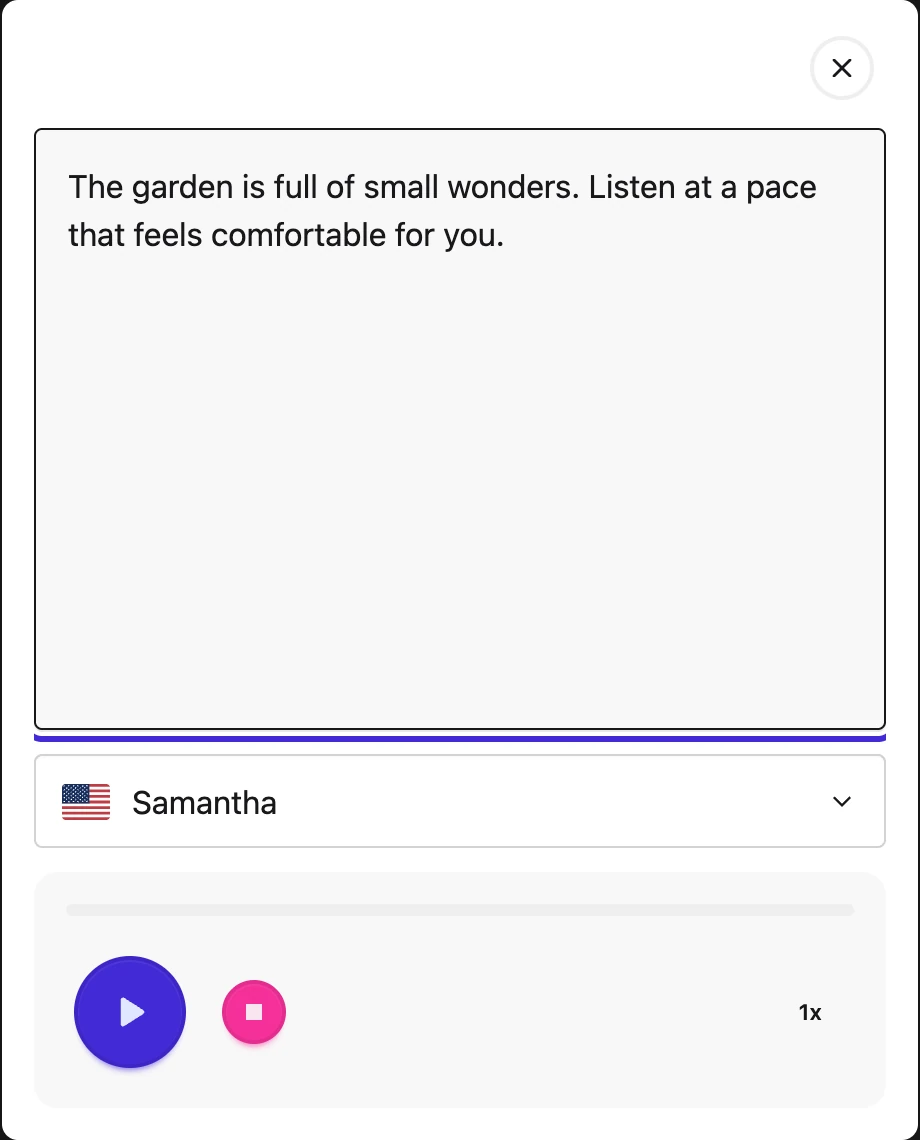
A panel will appear with a text area and playback controls.
 View full-size image (opens in a new tab)
Step 4: Play the Text
There are several ways to use Text to Speech:
Read the whole page - If you have not highlighted any text, click the play button. Helperbird will read all the text on the current page.
Read selected text - First, highlight the text you want to hear by clicking and dragging your mouse over it. Then click the play button. Helperbird will read only the highlighted text.
Read custom text - Type or paste text into the text box in the panel. Click the play button to hear that text read aloud.
Use Pause to pause a reading, or Stop to end it. Stop also cancels a reading that is still loading. Press Play when you want to listen again.
Step 5: Customize Settings
You can adjust how the text is read directly in the panel:
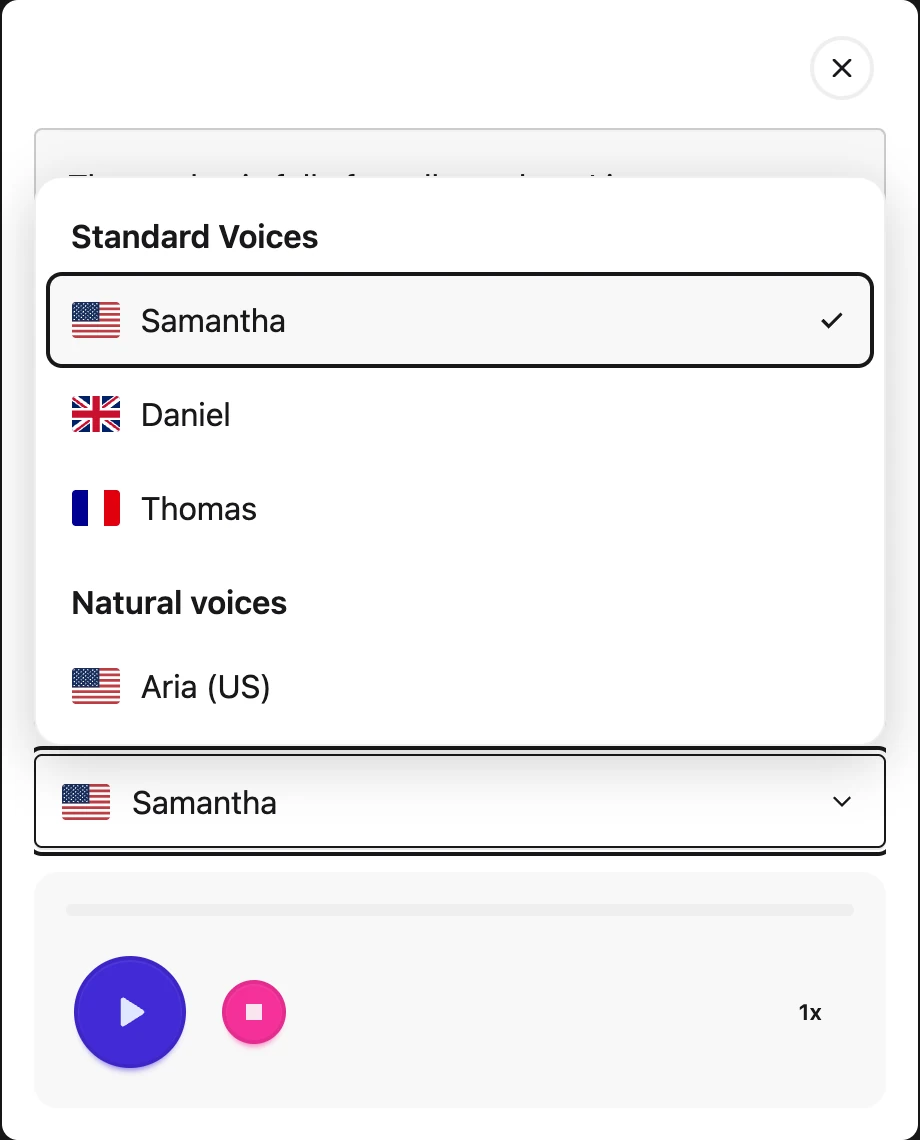
Voice - Use the voice dropdown in the panel to choose from different voices. You can select male or female voices in various accents.
Speed - Click the speed button (for example, 1x) in the player controls to cycle through playback speeds. A slower speed is good for learning, while a faster speed helps you get through content quickly.
Standard Voices use your browser or device's speech system. Voices that run locally can work offline. Natural voices need Helperbird Pro and an internet connection.
Flags beside voices identify their language or region. They are included as images, so they also display on Windows. Read the voice name and language when choosing; the flag is only an extra visual cue.
There is one set of playback controls. Theater mode and its seek bar are no longer available. To hear a passage again, stop, select that text and press Play.
Tip: You can also highlight text on any webpage, then use the Highlight Menu that appears to quickly access Text to Speech for that selected text.
The September 2026 update makes a one-time change for people upgrading from an earlier version: Text to Speech selects the first available voice under Standard Voices. This clears natural-voice selections left over from trials or promotions. Your speed and pitch stay the same. You can choose another voice at any time; natural voices need Helperbird Pro. Later updates keep your choice.
 View full-size image (opens in a new tab)
If the browser popup is short or your text is enlarged, scroll inside the panel to reach the voice and playback controls. The Close button remains available at the top.
The premium voice group is now called Natural voices. It is the same group previously called Neural Voices. See voice settings for availability.
Frequently Asked Questions
Why isn't Text to Speech working? First, check that your device volume is not muted. Also check that the browser tab isn't muted (look for a speaker icon in the tab). If it still doesn't work, try refreshing the page or restarting your browser.
Can I use Text to Speech offline? Some voices require an internet connection to work. If you're offline, only local system voices will be available.
How do I change the voice language? In the voice dropdown in the panel, look through the available voices. Voices are named by language and accent (e.g., "English (US)", "English (UK)", "Spanish").
Does Text to Speech work on PDFs? Yes! Open the PDF in Helperbird's PDF reader and you can use Text to Speech on the document content.
How do I read selected text in Google Docs? Select the words in your document, then click Play in Helperbird's floating toolbar. You can drag over the text or hold Shift and use the arrow keys. There is no need to copy and paste.
If Helperbird cannot read the selection, refresh the Google Docs tab and select the words again. Try a shorter section that is visible on screen. Google Docs selections play without Helperbird's word-by-word highlighting. If a selection cannot be read, Helperbird asks you to select text instead of switching to the whole document.
Can I read text inside an embedded lesson? Try Read text in online lessons, an optional beta that is off by default. It works with supported selectable text inside a lesson. Support varies by platform.
Why did speech stop when I closed the floating toolbar? Closing or collapsing the toolbar stops its read-aloud and voice-typing sessions. Reopen it when you are ready to continue.
Can I use keyboard shortcuts? Yes, you can use keyboard shortcuts to control playback. Check the Helperbird settings for the available shortcuts.
Related Guides
Video Tutorial
Need Additional Help?
If you have any questions or run into any issues, please contact the Helperbird support team. You can reach us at Helperbird support. We are happy to help you get the most out of Helperbird.
Printed from the Helperbird Help Center · Updated October 12th, 2026
Questions? We are happy to help — helperbird.com/support